
TL;DR: As labor shortages, hiring delays, and turnover continue to challenge US employers, many organizations are turning to offshore staffing for US labor shortages as a long-term continuity strategy rather than a temporary staffing fix. By building Philippine-based offshore teams through a managed staffing partner, businesses can reduce dependence on a single domestic labor market before hiring shortages start affecting performance.
There is a version of this problem that every operations leader recognizes. Someone key leaves. A contractor does not renew. A hire falls through at week eight of a search. And for a few days — or a few months — a function that your business depends on every day starts to slow down. At first it looks like a staffing issue. Then it starts affecting throughput, SLAs, and customer experience. That is when it becomes something harder to fix: a structural risk.
For a growing number of U.S. employers, recurring turnover, sustained hiring delays, and a tightening labor market have made this risk the norm, not the exception. The question is no longer how to fill the next vacancy faster. It is how to build a workforce model that keeps performing even when domestic hiring conditions do not cooperate.
Companies that address these disruptions one hire at a time remain reactive. Companies focused on resilience are taking a different approach. They are using offshore staffing for US labor shortages as a structural layer that supports distributed team operational continuity, reduces the impact of turnover, and leverages Philippine workforce reliability to keep critical functions running.
That strategy has a name. And it starts with rethinking where your workforce comes from.
The Hidden Cost of U.S Labor Shortages
Most organizations calculate the cost of a vacant role in direct terms: recruiting fees, job board expenses, and manager time spent interviewing candidates. The larger cost is often what happens while the position remains unfilled.
A customer support queue grows by 20% after two agents leave. A billing cycle slips by a week when a processor exits mid-month. A data operations team misses SLAs while a backfill search stretches into its third month.
These are not isolated incidents. They are the operational consequences of workforce shortages and prolonged hiring timelines.
The financial impact extends far beyond recruitment costs. The Society for Human Resource Management estimates that replacing an employee can cost between 50% and 200% of annual salary when recruiting, onboarding, and lost productivity are factored in — and those figures do not account for lost throughput, delayed service delivery, or customer experience disruptions.
The organizations most exposed to these risks tend to operate in functions where work cannot simply pause:
- Customer operations and contact centers — service demand continues regardless of staffing levels.
- Healthcare administrative support — compliance and throughput requirements must be maintained regardless of headcount.
- Back-office functions such as billing, claims processing, order management, and data entry, where delays compound quickly and errors carry downstream cost.
- Software QA and technical support, where specialized talent is difficult to source fast and even harder to replace at quality.
HIGHLIGHTS:
- Labor shortages become an operational risk when prolonged vacancies begin affecting service levels, productivity, and business continuity.
- The true cost of turnover extends beyond hiring expenses to include lost productivity, delayed work, missed SLAs, and customer experience disruptions.
- Continuity staffing differs from emergency outsourcing by building offshore capability proactively before staffing shortages affect performance.
- The Philippines offers structural advantages through deep talent availability, time zone alignment, operational resilience, and scalable workforce systems.
- A managed offshore staffing partner provides accountability for business outcomes through performance management, documentation, governance, and operational oversight.
- Organizations that invest early in how to reduce hiring dependency can build more resilient operations that continue performing despite turnover, hiring delays, and labor market volatility.
Which Roles Are Best Suited for Offshore Continuity Staffing?
Not every role is an equally strong candidate for an offshore team. The best starting points tend to share three characteristics: the work is process-defined, the output is measurable, and the function creates operational risk when left vacant.
Common examples:
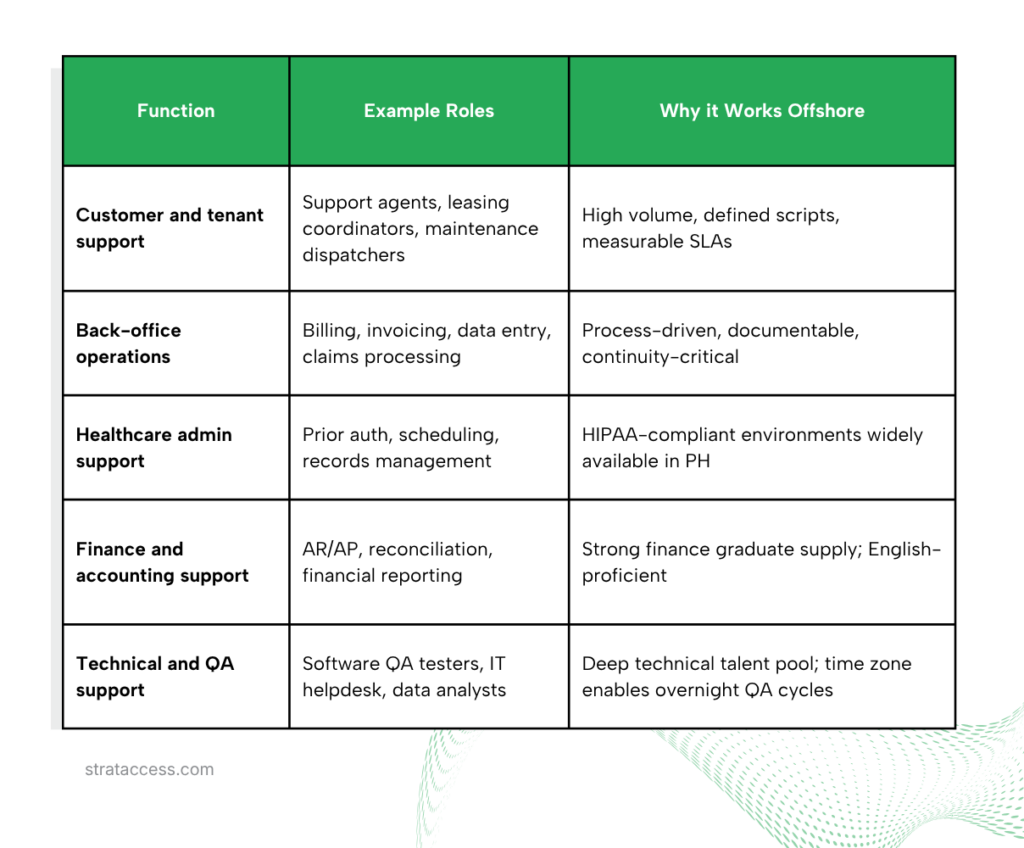
Roles that are highly judgment-dependent, require frequent in-person presence, or involve real-time client relationships are generally better kept onshore, at least initially. As offshore teams build institutional knowledge, many organizations gradually expand the scope.
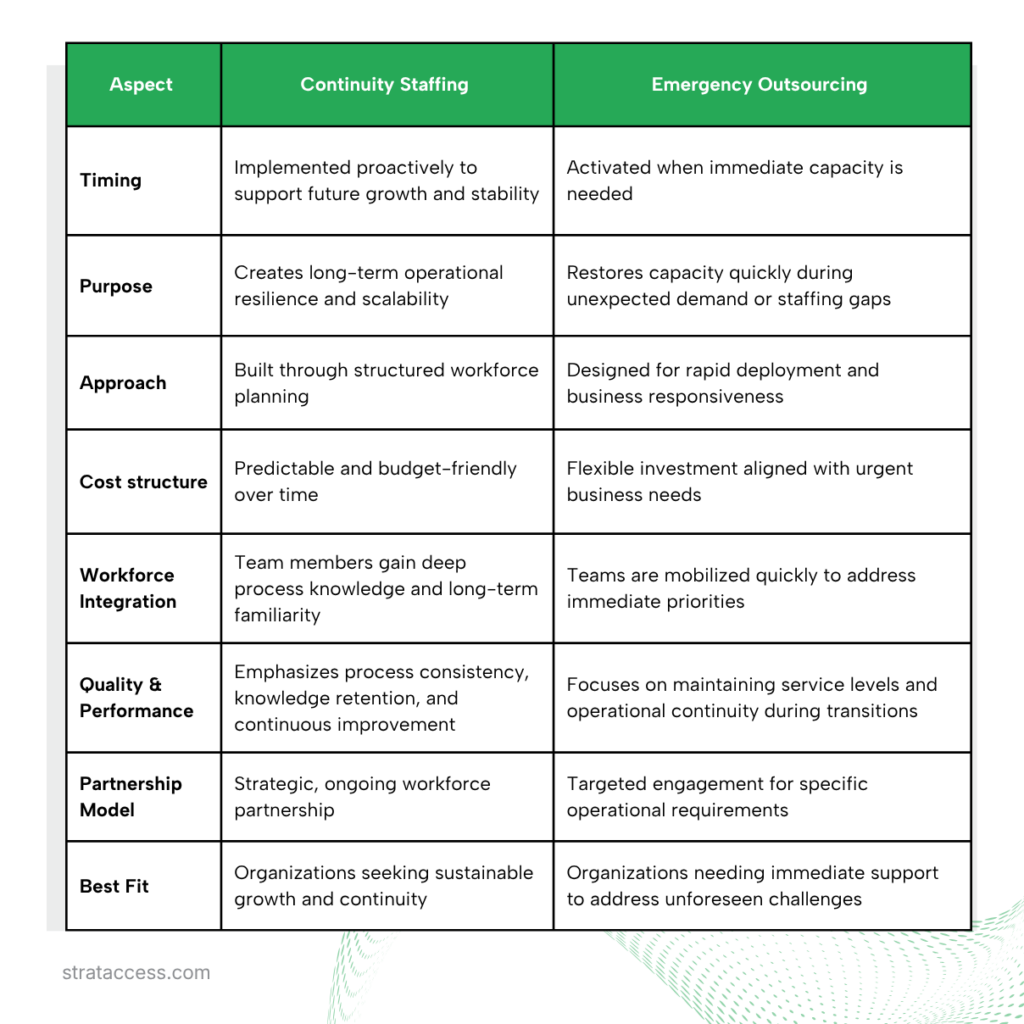
Why Continuity Staffing is Different from Emergency Outsourcing
When U.S. employers first explore offshore talent, the conversation often starts with cost reduction or an immediate staffing gap. Both are valid reasons to begin looking offshore, but neither is the foundation of a long-term workforce strategy.
Implementation Timeline: 60 to 90 Days
A continuity staffing model typically includes:
- Roles selected for their long-term operational importance and replacement difficulty
- Documentation and knowledge transfer embedded from day one
- Clear KPIs, SLAs, and performance accountability
- Ongoing oversight through a managed offshore staffing partner
For many back-office, customer support, administrative, and operational functions, implementation can typically be completed within 60 to 90 days.
A typical timeline includes:
Days 1–30: Planning and Partner Selection
- Function scoping and workflow assessment
- Documentation review
- Offshore partner selection and contracting
Days 31–60: Recruitment and Training
- Candidate sourcing and hiring
- Role-specific training
- Workflow shadowing and supervised onboarding
Days 61–90: Operational Integration
- Transition to steady-state operations
- KPI and SLA monitoring
- Performance feedback and process optimization
Timelines vary based on role complexity, documentation quality, and talent availability.
Why the Philippine Workforce Is Structurally Built for Continuity
Talent supply
The Philippines produces a steady pipeline of skilled professionals across a wide range of disciplines through a higher education system supported by more than 2,300 universities and colleges. This workforce depth provides employers with access to qualified professionals across multiple business functions, making it easier to scale teams and sustain long-term growth without facing significant talent constraints.
With a deep and continuously expanding talent pool, talent supply is consistently replenished rather than limited or cyclical. This makes hiring faster, scaling more predictable, and staffing disruption risk management more effective.
Time Zone Design for Continuous Operations
The 12 to 13 hours difference with the U.S. creates built-in overnight coverage. Philippine teams work while U.S. teams are offline, allowing work to progress continuously. This enables near 24-hour production cycles without U.S. overnight staffing, reducing delays and strengthening continuity across distributed teams.
Distributed Geographic Risk
The BPO ecosystem is spread across multiple regional hubs rather than concentrated in one location. If one area is disrupted, operations can shift to other locations, maintaining continuity. This structure also broadens access to specialized talent across multiple labor pools.
Standardized Systems for Scaling
The outsourcing ecosystem uses well-established training and onboarding systems built over decades of BPO experience. This makes new hires productive faster and reduces performance differences across teams. For organizations pursuing U.S. labor shortage solutions, it creates stable, predictable execution capacity instead of short-term staffing fixes.
Embedded Operational Resilience
Most delivery environments include safeguards such as backup connectivity, disaster recovery systems, and distributed work setups. This helps keep operations running during disruptions that would otherwise stop centralized teams.
All of these factors combine to make continuity a design principle, not an afterthought. Talent supply, geography, time zones, and standardized systems work together to support steady execution particularly for workforce continuity strategies built around a managed offshore staffing partner.
The key advantage is not just access to talent, but the ability to keep operations running even when turnover, hiring delays, or labor shortages disrupt domestic teams
What a Managed Offshore Staffing Partner Delivers
A managed offshore staffing partner focuses not just on headcount but on function-level performance, making it a structural approach to U.S. labor shortage solutions, not just a headcount fix. The goal is ensuring work continues reliably despite turnover, hiring delays, or labor market constraints.
In practice, a managed model includes:
- Defined SLAs and ongoing monitoring: performance standards set up front with continuous reporting
- Escalation pathways: structured issue resolution without client-side firefighting
- Operational documentation: standardized workflows that reduce single-person dependency
- Regular performance reviews: early detection of issues before they affect output
Together, these strengthen staffing disruption of risk management by shifting accountability from individuals to system performance.
Dedicated Team vs. Shared Team Models
A key decision in offshore staffing is choosing between a dedicated team and a shared team.
For most core functions, dedicated teams are preferred because upfront training and documentation create long-term operational stability. Most organizations can have a functional offshore team in place within 60 to 90 days, enough time to establish continuity before the next vacancy creates disruption.
Compliance and Security: What U.S. Employers Need to Know
For organizations exploring offshore staffing for US labor shortages, compliance and security should be part of the planning process from the beginning. When the right safeguards are in place, offshore teams can support long-term growth while maintaining operational and regulatory standards.
Data Protection and Intellectual Property
Any offshore team handling customer information, financial records, or proprietary processes should operate under clear data protection controls. Key safeguards include:
- Employee-level NDAs, not just company-level agreements
- Role-based access controls
- Documented data handling procedures
- Clear policies on where data is stored and processed
Industry-Specific Compliance
Organizations in regulated industries should verify that offshore partners can support their compliance requirements. For healthcare and insurance organizations, this may include HIPAA-compliant processes, Business Associate Agreements (BAAs), access logging and audit trails, documented incident response procedures, and compliance-trained personnel.
The goal is not simply to check a compliance box, but to ensure offshore operations can support business continuity without creating additional risk.
How to Assess Readiness for Offshore Assessment?
Before implementing offshore staffing for US labor shortages, it helps to assess whether your organization is prepared. This framework can help identify which functions are suitable for offshore support and what needs to be in place for a successful transition.
1. Function Audit: Where Is the Risk?
Start by identifying roles that create the greatest operational disruption when left vacant.
Ask:
- How difficult is this role to fill?
- How long does hiring typically take?
- What happens when the role is understaffed?
- Can the work be documented and standardized?
Functions that are high-impact, difficult to hire for, and process-driven are often the strongest candidates for offshore support.
2. Documentation Readiness: Can the Work Be Transferred?
Successful offshore teams depend on clear documentation.
Review whether you have:
- Documented workflows and procedures
- Defined quality standards
- Training materials for new hires
- Critical knowledge that exists only with specific employees
If key processes are undocumented, addressing those gaps should come before any transition. Documentation is a foundation of distributed team operational continuity.
3. Compliance Requirements: What Rules Apply?
Before selecting an offshore model, understand the compliance requirements that govern the work.
Consider:
- Does the role handle customer, financial, or healthcare data?
- Are there industry requirements such as HIPAA, SOC 2, or PCI-DSS?
- Are there restrictions on how data is stored or transferred?
Addressing these requirements early strengthens staffing disruption risk management and helps avoid costly adjustments later.
4. Accountability and Governance: How Will Performance Be Managed?
The success of an offshore team depends on clear accountability.
Define:
- KPIs and service-level expectations
- Escalation procedures when issues occur
- Performance review processes and reporting cadence
- Ownership of the offshore relationship
This is especially important when working with a managed offshore staffing partner, where accountability extends beyond staffing to operational performance.
Organizations often focus first on finding talent. Equally important is ensuring the operation is ready to support that talent. When functions are documented, compliance requirements are understood, and governance structures are defined, you can leverage the Philippine workforce advantage more effectively.
The goal is not simply to fill vacancies. It is to reduce dependence on a single labor market while building the operational stability that keeps critical functions running regardless of what domestic hiring conditions do next.
Building Workforce Continuity Before Staffing Shortages Become Disruptive
You now know what the problem actually costs, which roles carry the most risk, and what a structured offshore model looks like when it is built for continuity rather than coverage. The question is whether you act on it before the next disruption or after.
Labor market conditions will continue to shift. Turnover will keep happening. Hiring timelines will stay unpredictable. But critical business functions still need to perform. The organizations best positioned for growth are not waiting for conditions to improve. They are building workforce models that reduce dependence on a single talent market before staffing gaps start affecting performance.
For many employers, the Philippines has become a key part of that strategy. Through offshore staffing for US labor shortages, businesses can access a workforce ecosystem built for continuity, scalability, and long-term operational stability. The advantage is not simply access to talent. It is access to a system designed to keep operations running when domestic hiring conditions become unpredictable
We at StratAccess strive to build long-term relationships that extend beyond the typical vendor-client transactions. Combined with the skill and knowledge of the Philippine outsourcing industry, our company continues to play an important role in connecting clients with qualified, quality, and cost-effective BPO referrals.