
Overview: U.S. talent shortages are slowing growth and increasing labor costs across industries. Offshoring to Philippines offers a practical solution by providing skilled, English-proficient professionals, strong cultural compatibility, and significant cost advantages. With flexible outsourcing models, supportive government infrastructure, and proven quality controls, companies can build reliable offshore teams that improve hiring speed, enhance operational resilience, and scale efficiently without sacrificing performance or compliance.
Widening U.S. hiring gaps are slowing growth and stretching local teams thin. Offshoring to the Philippines provides skilled, English-proficient professionals supported by strong infrastructure and cultural alignment, transforming these gaps into strategic opportunities.
By leveraging Filipino outsourcing, organizations can turn talent shortages into competitive advantages, combining cost efficiency, operational flexibility, and long-term resilience.
Back-office outsourcing and specialized offshore teams enable faster scaling, smoother workflows, and consistent quality, making offshoring a practical lever for sustainable growth.
U.S. Talent Crisis in 2026
The national unemployment rate rose to 4.4% in February from 4.3%. signaling a modest but notable shift in the labor market. While the increase may seem small, it reflects underlying structural pressures, including tightening talent pools, sector-specific skill gaps, and heightened competition for qualified professionals.
The Labor Department reported an estimated 231,000 initial jobless claims for the week ending January 31, marking a rise of 22,000 from the previous week.
Delays hurt businesses. Losses mount fast from open slots.
Skills Gaps Widened
Organizations face increasing skills gaps. Companies struggle to fill specialized roles in tech, finance, and operations as retirements, technology shifts, and training gaps shrink the local talent pool.
Unemployment
The U.S. economy shed a significant number of jobs in February, and the unemployment rate edged higher compared with the previous month. This shift reflects a broader softening in the labor market amid slower hiring and structural workforce pressures that make it harder for companies to fill open roles and meet demand.
Government Cuts and Freezes
Government spending cuts have slowed hiring in scientific research and development. While overall job postings rose above pre-pandemic levels, research and development roles fell 29% below, highlighting a persistent talent gap.
Demand of AI Skills
AI development and AI literacy now lead the most in-demand skills globally, surpassing traditional IT and data roles, as companies shift their strategic talent focus on AI-driven capabilities.
Economic Fallout
Slower U.S. economic growth has contributed to hiring gaps, as weaker demand and cautious expansion make it harder for companies to fill specialized roles.
Why the Philippines is the Strategic Solution
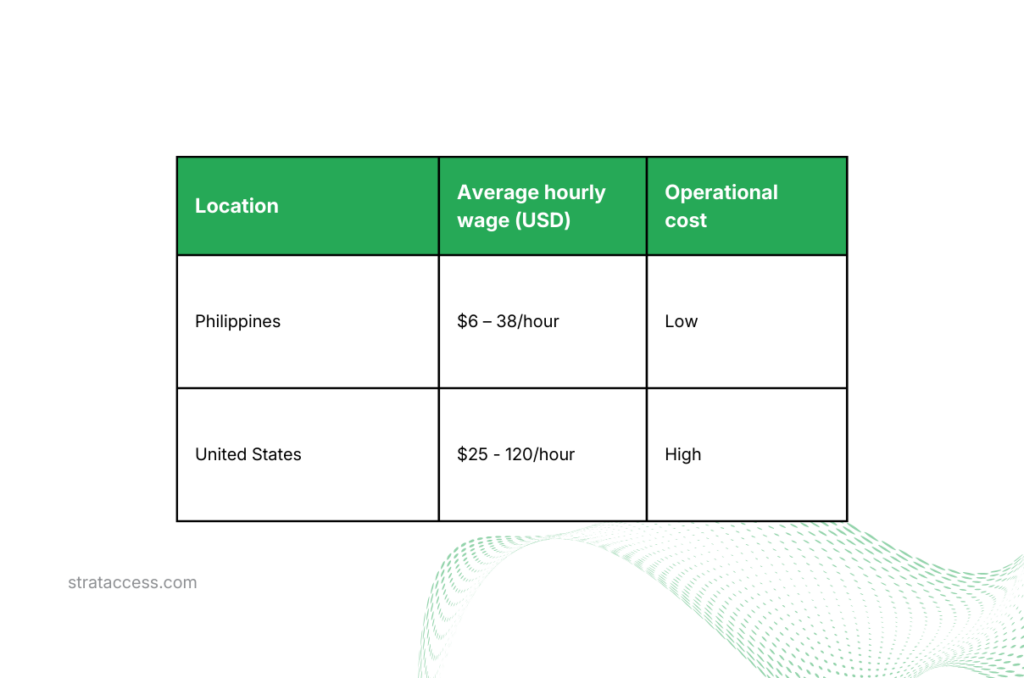
Companies that outsource work to Philippines get skilled teams, 40-70% savings, and quick scaling. From back-office outsourcing solutions to broader Filipino outsourcing strategies, global teams help stabilize workflows and reduce strain on local staff.
Supported by experienced outsourcing companies in the Philippines, businesses minimize hiring delays, protect expansion timelines, and extend operational capacity with greater confidence and get immediate access to 1.9M skilled BPO pros.
Deep Talent Pool
The Philippines combines strong English proficiency with an education system aligned to global business needs.
Graduates in finance, IT, engineering, healthcare, and business administration provide a steady pipeline of talent, enabling smooth communication and reliable support across diverse operational roles.
Cost-savings Fill Economic Gaps
Labor costs remain structurally lower across most roles, while deeper talent pools reduce competitive pressures, making long-term workforce expenses more stable and predictable.
Here is a basic cost comparison table for offshoring to Philippines vs. U.S. hiring.
IT/AI Support Specialist
U.S. AI skills demand exploded, top shortage in 2026. Philippines delivers the same expertise at lower cost having Certified Information Systems Security Professional (CISSP), Certified Information Security Manager (CISM), and Certified Ethical Hacker (CEH) holders.
Government Support Enhances Operational Stability
The Philippine government actively strengthens the outsourcing ecosystem through initiatives from the Philippine Economic Zone Authority and the Department of Information and Communications Technology.
Key programs include IT infrastructure development, investment incentives, workforce training, and data privacy and cybersecurity standards.
Together, these measures help reduce operational risk and provide a stable environment for foreign employers.
Professionalism and Cultural Alignment
Filipino teams bring a strong work ethic, valuing reliability, accountability, and long-term employment, which supports higher retention.
Their familiarity with Western business norms ensures smooth collaboration with U.S. teams, while overlapping time zones help minimize delays and structural coordination challenges.
HIGHLIGHTS:
- U.S. hiring delays and rising labor costs make local recruitment alone unsustainable.
- The Philippines offers a skilled, English-proficient workforce aligned with Western business practices.
- Flexible outsourcing models allow companies to balance speed, control, and scalability.
- Cost advantages extend beyond wages to overhead reduction and operational efficiency.
- Strong governance and communication frameworks maintain quality and reduce risk.
- Offshore teams become long-term assets that strengthen resilience and enable sustainable growth.
Understanding Outsourcing Models and Costs
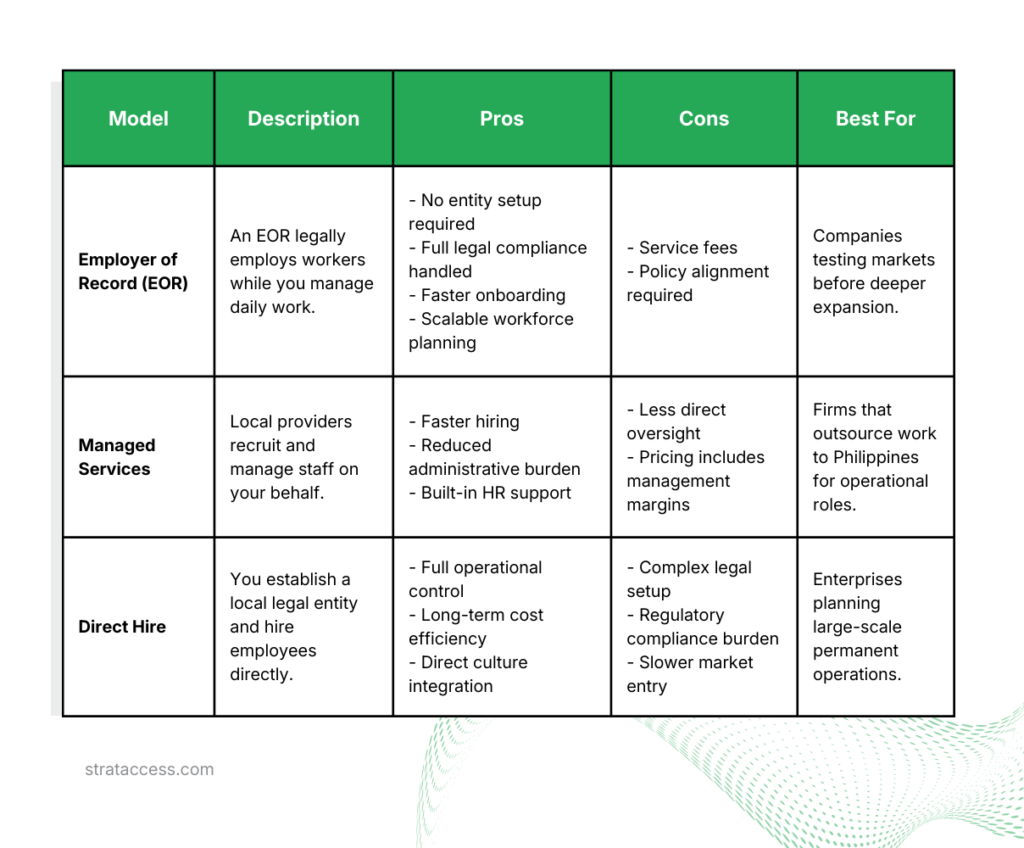
Not all offshore structures in the Philippines operate the same way. Selecting the right model shapes your cost efficiency, operational control, and compliance responsibilities.
The best approach depends on your company’s scale, expansion timeline, and risk tolerance.
ROI Framework Leaders Use
Time-to-hire improves significantly, many roles fill in weeks, not months. Retention strengthens value, as offshore pros prioritize stability.
Direct Savings
- Salary differentials
- Lower benefits costs
- Reduced facility overhead
Indirect Value
- Faster project completion
- Extended service hours
- Reduced burnout among local teams
- Improved scalability
Strategic Gains
- Access to specialized talent
- Market expansion flexibility
- Stronger operational resilience
Ensuring Quality and Managing Risk
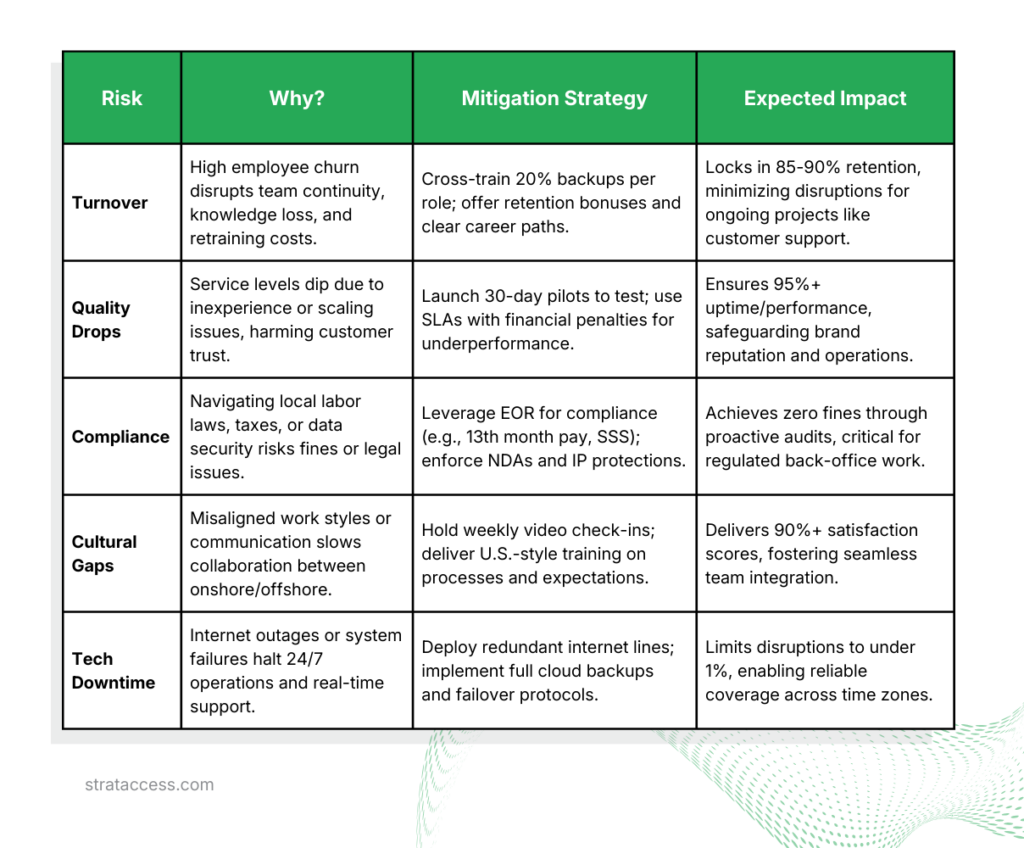
Quality lapses erode ROI, making strong safeguards essential. When offshoring to Philippines, organizations cannot afford performance gaps or hidden operational risks.
Smart leaders build safeguards from day one.
Focus on proven frameworks, tools, and strategies that keep performance high and issues low.
Quality Assurance Frameworks
Leading firms establish standard operating procedures, KPI dashboards, audit mechanisms, and structured reporting cycles to maintain operational visibility and accountability.
Clear expectations across teams help ensure consistency, performance stability, and reliable execution.
Communication Infrastructure
Teams use collaboration platforms to maintain visibility and alignment.
Strong communication practices reduce coordination gaps, improve workflow transparency, and keep distributed teams working in sync.
Risk Mitigation Strategies
Proven strategies mitigate key outsourcing challenges, ensuring measurable results and smooth shifts to capability-building.
How EOR Services Simplify Expansion
One contract, no entity. Employer of Record (EOR) providers act as the legal employer, letting you hire and scale in the Philippines instantly without setting up a subsidiary or navigating red tape.
EOR providers manage:
- Employment contracts: Draft compliant agreements (fixed-term or indefinite), including probation periods, termination notices, and non-compete clauses tailored to local laws.
- Payroll processing: Run accurate monthly payrolls, factoring in the mandatory 13th-month pay (one month’s salary bonus by December) and deductions.
- Benefits administration: Manage statutory contributions like SSS (social security/pensions), PhilHealth (healthcare), Pag-IBIG (housing fund) plus holiday pay, service incentives, and leaves.
- Tax compliance: Withhold BIR income taxes, file annual ITRs, and issue certificates for your team’s filings.
- Local labor law adherence: Ensure compliance with DOLE rules like 8-hour workdays, overtime premiums, 105-day maternity leave, 7-day paternity leave, and 13 annual paid holidays.
This reduces internal legal strain and lets you focus on capability-building with zero compliance risks.
Action Guide for Decision-Makers
Choosing the right offshore approach depends on your organization’s size, operational complexity, and growth objectives.
Mid-Sized Business (50-500 employees)
- Keep it simple and low-risk: Begin with straightforward, high-ROI functions like admin support, customer service, or data entry; these deliver quick wins without overhauling operations.
- Pilot small for proof: Hire just a small headcount initially to test fit, quality, and integration. This minimizes upfront investment while validating 20-40% gains in output and speed.
- Leverage EOR for speed: Go live in weeks, not months, no need for local entity setup. EOR handles contracts, payroll, and compliance, letting you scale confidently.
- Measure early success: Track metrics like task completion rates or response times to confirm efficiency boosts, then expand to specialized roles.
Enterprise (500+ employees)
- Build comprehensive teams: Target complex areas like finance, IT development, or full operations, leveraging the Philippines’ depth in back-office and tech talent.
- Adopt hybrid models: Pair U.S.-based strategy with Philippine delivery for cost-effective execution, seamless time zone overlap, and innovation.
- Forecast long-term: Plan 12–24-month workforce ramps with detailed projections, aligning hires to business expansion and capability needs.
- Invest in leadership. Identify and promote top Filipino performers into supervisory roles, fostering loyalty, knowledge retention, and a true extension of your culture.
Building a Resilient Workforce Strategy
Workforce constraints have become a structural business challenge, and local hiring alone can no longer meet demand shifts or specialized skill shortages.
Strategic offshoring to the Philippines provides a practical path forward, letting companies outsource work while maintaining continuity, controlling costs, and expanding workforce flexibility without sacrificing quality. With outsourcing in the Philippines solutions guided by experienced consultants, such as StratAccess, offshore teams become long-term operational assets that strengthen resilience and support confident, sustainable scaling.
We at StratAccess strive to build long-term relationships that extend beyond the typical vendor-client transactions. Our primary focus is to successfully promote and serve each client’s products or services as though they are our own. Combined with the skill and knowledge of the Philippine outsourcing industry, our company has positioned itself as a leader in delivering its clients access to qualified quality and cost-effective BPO referrals.