
Overview: Customer service continuity has become a core operating requirement driven by real-time customer expectations and demand volatility. Philippine BPO managed services enable 24/7 stability by integrating staffing, monitoring, and escalation into a unified control system, supported by infrastructure redundancy, workforce depth, and multi-site delivery. This shift outsourcing customer service from reactive support to a continuity-driven operating model where performance is designed, not repaired.
Customer service continuity is becoming a core driver of business performance in a real-time, always-on economy where expectations continue to rise.
Customers increasingly expect fast, seamless resolution, not just 24/7 availability. At the same time, AI-enabled competitors are raising service standards, making speed, consistency, and accuracy baseline expectations across industries.
These expectations operate alongside more dynamic demand conditions. Digital-first businesses now experience rapid shifts in volume driven by product launches, seasonal cycles, system events, and viral customer engagement. In this environment, support operations need to scale and adapt quickly while maintaining consistent service quality.
As a result, customer service is now closely tied to real-time business performance, where responsiveness influences conversion, retention, and customer experience within the same interaction cycle.
This is why outsourcing customer service has evolved from a cost-efficiency approach into a continuity-focused strategy. Many organizations work with a call center in the Philippines ecosystem and established BPO companies to deliver stable, always-on support through managed service models designed for operational resilience and scalability.
The Real Cost of Customer Service Downtime for U.S. Firms
Most leaders frame downtime around system outages, infrastructure issues, or staffing gaps. Within business continuity, disruption is better understood as a spectrum of operational strain rather than a single point of failure. It can appear as a complete outage with no inbound or outbound support capability, degrade into long wait times and reduced agent availability, or emerge during peak failure when volume spikes overwhelm systems and staffing.
These scenarios are managed through capacity planning and operational redundancy rather than treated as structural failure. Unlike traditional downtime, the impact compounds across support queues, response times, and customer trust, and can persist even after operations stabilize, making service continuity a core priority for managed services.
The deeper cost structure looks different:
Customer loss extends beyond transactions
When customers cannot reach support, they rarely wait for resolution and just switch providers.
In high-touch services, support is not a secondary function. It is part of the product experience. Delays during onboarding, payment issues, account recovery, or service disruption directly influence whether a customer forms trust or exits early.
At these moments, even short response gaps can trigger churn because the perceived reliability of the entire service is questioned, not just the support interaction. Over time, this results in irreversible customer migration to competitors who demonstrate faster and more consistent responsiveness.
Customer acquisition cost (CAC) waste
Every customer interaction represents a portion of acquisition spend already committed through marketing, sales, onboarding, and conversion efforts. When support systems fail to respond effectively, the organization does not just lose a ticket; it loses the return on an entire acquisition cycle.
This becomes more severe in performance-driven growth models where CAC is justified by expected lifetime revenue. A single unresolved or poorly handled issue can break that economic assumption.
The customer may still exist in the database, but their value trajectory is effectively flattened. At scale, this creates structural inefficiency where acquisition continues, but realized value does not.
Reputation and review amplification
Service experiences today are highly visible and widely shared. Customers often communicate feedback across public channels such as review platforms, social media, and community forums, especially when issues remain unresolved or require follow-up.
What makes this impact disproportionate is not the volume of complaints but their visibility and persistence. A small cluster of unresolved tickets can generate disproportionate negative perception, shaping how prospective customers evaluate trust before engagement even begins. This introduces a compounding effect where operational issues directly influence marketing performance, reducing conversion rates, and increasing skepticism at the top of the funnel.
Customer lifetime value (CLV) erosion
Customer lifetime value is highly sensitive to consistency of experience rather than isolated interactions. While a single incident may not always cause churn, repeated inconsistency in response quality, speed, or resolution accuracy gradually reduces engagement depth.
Customers begin to reduce usage frequency, downgrade plans, or avoid expansion within the platform. Even when retention technically holds, revenue per customer declines over time. This silent erosion is often less visible but materially more damaging because it reduces long-term revenue efficiency without triggering immediate alarm signals in standard retention metrics.
Competitive displacement and revenue leakage
In competitive service environments, responsiveness functions as a market differentiator. When customers experience delays in resolution, they actively reassess alternatives that offer faster support, clearer communication, or more predictable service outcomes.
Delays do not only risk dissatisfaction. They actively create conversion opportunities for competitors. As a result, revenue leakage occurs not only through churned customers but also through lost expansion opportunities and redirected high-intent prospects.
Operational strain beyond frontline support
Customer service disruption does not remain isolated within support teams. It cascades into adjacent operational layers. As queues build, agents become overloaded, resolution times extend, and SLA commitments begin to fail.
This creates downstream effects such as delayed product releases, increased dependency on engineering teams for issue triage, and diversion of technical resources away from development priorities. Instead of focusing on system improvement, teams spend increasing time stabilizing service conditions. Over time, this reduces organizational velocity and introduces inefficiencies across multiple departments.
Structural limits of in-house models
Traditional in-house support models are constrained by structural factors that are difficult to scale rapidly. Staffing is finite; coverage is limited by geography and time zones, and maintaining redundancy requires significant fixed cost investment.
As a result, many organizations operate with theoretical resilience rather than operational resilience. Business continuity planning often exists as documentation or contingency design but is not fully stress-tested under real-world demand conditions. This gap becomes most visible during volume spikes, unexpected disruptions, or extended support demands that exceed planned capacity.
These constraints are addressed through distributed coverage, scalable staffing structures, and managed service design that prioritizes continuity as an operational baseline rather than an exception.
HIGHLIGHTS:
- Customer service continuity is now an operating requirement, not a support function.
- Downtime in outsourcing customer service creates cascading impacts across revenue, trust, and operational performance.
- Managed BPO services unify staffing, monitoring, and escalation into a single control system for stability.
- 24/7 continuity is maintained through real-time monitoring and automated operational adjustments.
- The Philippines supports continuity through infrastructure redundancy, workforce depth, and multi-site delivery.
- Sustained performance depends on operating model design, not isolated tools or headcount.
Managed Services Models in Outsourcing Customer Service: What “Managed” Really Means
Managed services in outsourcing customer service represent a shift from labor provision to operational control. The distinction is not only who performs the work, but how systems are owned and coordinated to support service continuity.
In-house support models provide strong internal control and deep organizational alignment. As operations expand across time zones, channels, and demand peaks, coordination becomes more complex, requiring greater effort in staffing alignment, tooling integration, and capacity planning to maintain consistent performance at scale.
Traditional outsourcing focuses primarily on capacity extension. It enables access to skilled labor, while operational responsibility is typically shared between client and provider. In practice, this can require tighter coordination across workflows, escalation paths, and real-time adjustments during periods of fluctuating demand.
Managed services bring these elements together under a unified operating structure. Staffing, monitoring, and escalation are managed as part of an integrated system aligned to service-level outcomes. This reframes managed services not as a staffing model, but as a structured approach to performance management, operational stability, and continuity.
This is where call center built on managed service models stand out. They are designed not only to provide workforce capacity, but to operate as coordinated service systems that maintain continuity through integrated oversight, standardized processes, and real-time operational responsiveness under varying demand conditions.
There are three primary managed models:
1. Horizontal and Vertical Managed Models
Horizontal models
These cover cross-industry functions such as customer support, HR operations, finance and accounting, IT helpdesk, supply chain coordination, and analytics.
They are designed for scalability and standardized execution, enabling consistent SLA performance across different business types.
Vertical models
These are industry-specific services built for higher complexity and compliance requirements.
Examples include healthcare support with regulatory constraints, fintech operations involving secure transactions, and SaaS support covering onboarding and technical assistance.
These models rely on domain expertise to maintain accuracy, compliance, and service continuity in specialized environments.
2. Core Managed Service Delivery Structures
Fully Managed Model
The provider owns end-to-end operations, including hiring, training, QA, workforce management, and performance monitoring. This structure is typically used when organizations need rapid scaling, consistent execution, and reduced internal operational load, with service delivery fully governed against SLAs.
Co-Managed Model
Responsibility is shared. The provider handles daily operations, while the client retains strategic control over customer service direction, escalation policies, and service standards. This model is common for organizations with established internal customer support teams that require scalable execution support.
3. Supporting Delivery Variants
Cloud-based delivery
Enables distributed operations on scalable infrastructure, allowing remote teams to expand or contract capacity efficiently based on demand.
Omnichannel or hybrid delivery
Unifies voice, chat, email, and digital support channels into a single operating framework, often enhanced with automation for consistent cross-channel service delivery.
Build-Operate-Transfer (BOT) model
A phased operating structure where the provider establishes and runs the offshore function, stabilizes performance under agreed service standards, and transitions ownership to the client after a defined period. It is commonly used for long-term offshore expansion or phased market entry, allowing organizations to achieve operational readiness before taking full internal control.
Inside 24/7 Monitoring in Outsourcing Customer Service Operations
“24/7 support” is often used as a blanket term, but in practice, continuity is not defined by availability alone. It depends on what is actively monitored, how early risks are detected, and how quickly operations can respond before service levels are affected.
It is designed to maintain service stability across time zones, demand fluctuations, and operational dependencies. This means visibility is not limited to whether agents are online. It extends to how the entire service function is performing in real time and how quickly it can adapt under pressure.
Multiple Operational Layers
In mature outsourcing customer service operations, monitoring is structured across multiple operational layers that work together to sustain consistent performance, control variability, and ensure service continuity under changing demand conditions.
1. Demand Monitoring
Focuses on real-time demand signals to anticipate and manage workload fluctuations.
This includes tracking call and ticket volumes, queue lengths, and channel distribution across voice, chat, and email.
The objective is early detection of surges, so capacity can be adjusted before service levels are impacted.
2. Service Performance Management
Measures how effectively the operation is meeting defined SLAs.
Core indicators include average wait time, abandonment rate, first response time, and resolution time. Continuous monitoring ensures that deviations are identified and corrected in real time.
3. Workforce Management
Tracks agent availability and utilization to maintain coverage.
This includes active versus idle capacity, adherence to schedules, and shrinkage factors such as absences and breaks. The goal is to align staffing levels dynamically with demand conditions.
4. Quality and Compliance Oversight
Evaluates the consistency and accuracy of service delivery.
Monitoring includes call scoring trends, script adherence, and regulatory or policy compliance flags. This layer ensures that scaling operations do not compromise service quality or compliance standards.
5. System and Infrastructure Health
Ensures the underlying technology stack supports uninterrupted operations.
This includes CRM uptime, telephony performance, ticketing system latency, and overall platform stability. Resilience mechanisms such as redundancy and failover readiness are critical at this layer.
These operational layers do not operate in isolation. Their effectiveness depends on how signals are interpreted and acted upon within the service environment.
In practice, this creates two distinct operating behaviors in outsourcing customer service: reactive and proactive models.
Operating Behaviors in Service Continuity
The way monitoring data is used determines whether an operation stabilizes issues after impact or prevents them before escalation.
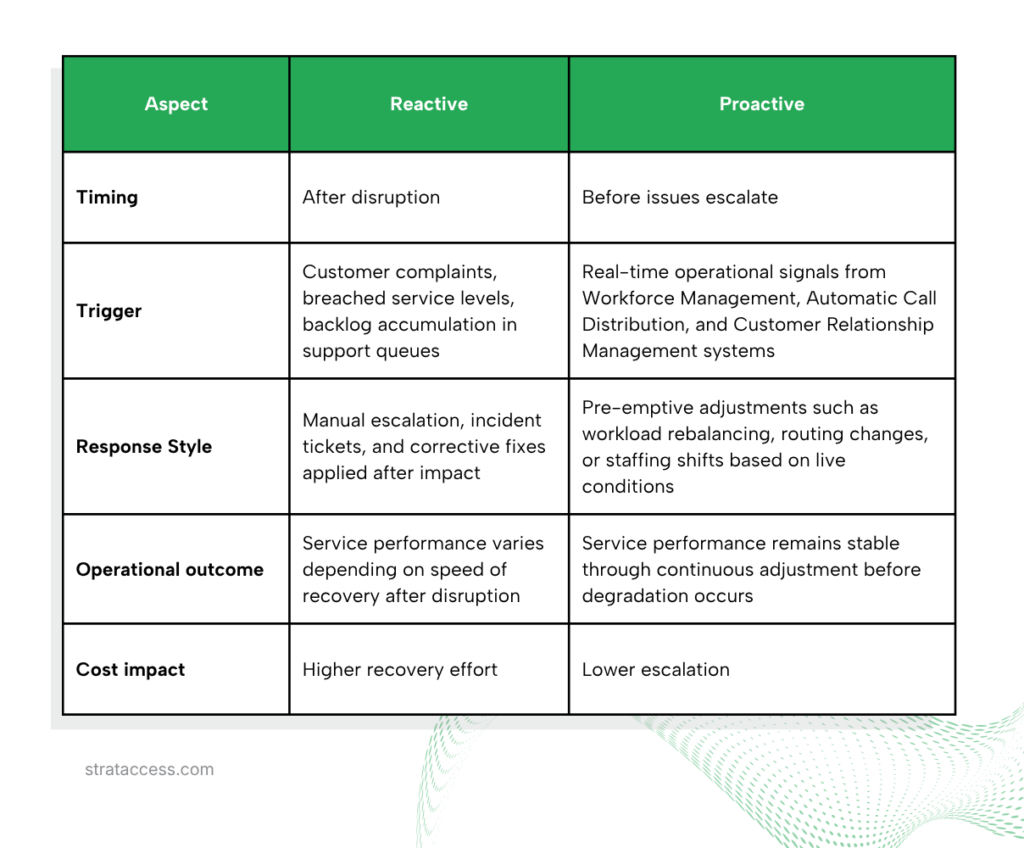
How Monitoring Systems Enable 24/7 Continuity
Monitoring systems shift operations from reactive problem-solving to proactive stability by combining real-time visibility, automation, and predictive control to prevent disruption in customer service environments. In operations, this approach is central to maintaining consistent service levels across high-volume, always-on support models.
Continuous monitoring of operational signals such as queue build-up, call volume changes, and agent availability allows potential issues to be identified early, often before SLA breaches occur. This early detection is paired with automated adjustments that can rebalance workloads, reroute interactions, or adjust staffing coverage in real time, reducing the need for manual intervention during demand spikes.
At the same time, live dashboards provide supervisors with immediate visibility into service levels, quality metrics, and queue conditions, enabling fast operational decisions while issues are still developing rather than after escalation. Over time, predictive analysis strengthens this model by using historical and real-time data to anticipate demand patterns and optimize scheduling and capacity planning in advance, supporting broader business continuity outsourcing objectives.
These capabilities are enabled through the integration of Workforce Management, Automatic Call Distribution, and Customer Relationship Management systems, which connect staffing, routing, and customer context into a unified operational view. In mature BPO companies in the Philippines, this integrated structure ensures service stability and reduces the likelihood of customer service disruption, even under fluctuating demand or operational stress.
Why Philippine BPOs Are Structurally Built for Continuity
The Philippines functions as a continuity-oriented delivery ecosystem for outsourcing customer service, where infrastructure, workforce scale, and operational maturity are aligned to sustain stable performance under variable demand conditions. Within this ecosystem, managed services offered by BPO companies play a critical role by taking full operational ownership integrating people, processes, technology, and performance management into a single accountable framework designed specifically to prevent customer service disruption.
In outsourcing call center in the Philippines, this configuration supports consistent 24/7 delivery not as an exception, but as an embedded operating baseline across peak periods, fluctuations, and disruption scenarios. Managed services providers proactively monitor, optimize, and adjust operations in real time, ensuring continuity is actively managed rather than passively maintained.
This continuity capability is not driven by a single factor, but by how multiple system layers interact to maintain service stability at scale.
Infrastructure resilience and distributed delivery design
Providers operate with layered redundancy across power supply, network connectivity, cloud infrastructure, and geographically dispersed delivery sites. Under Managed Services, this infrastructure is continuously monitored through centralized command centers and SLAs tied to uptime and recovery metrics. This reduces dependency on any single operational node and allows service continuity to be maintained even when localized disruptions occur.
The result is not just uptime protection but sustained operational availability across shifting conditions.
Workforce depth and demand absorption capacity
A large pool of English-proficient talent enables rapid scaling and sustained coverage across time zones. Managed Services providers go further by maintaining pre-trained talent pools, cross-skilled agents, and flexible staffing models that can be deployed immediately.
This depth creates built-in capacity buffers that allow organizations to absorb demand spikes without immediate degradation in response times or service quality, directly minimizing risks of customer service disruption. In practice, this supports continuity during both predictable peaks and unexpected surges.
Multi-site operating models and continuity routing
Leading BPO companies in the Philippines typically operate across multiple delivery locations, enabling workload redistribution when one site experiences strain or disruption. Within a Managed Services framework, this is supported by intelligent routing systems, real-time workforce management tools, and predefined failover protocols.
Combined with established disaster recovery frameworks and remote-work readiness, this creates a structural ability to reroute operations rather than pause them during instability events.
Operational maturity and service standardization
Beyond infrastructure and staffing, continuity is reinforced through standardized operating systems for training, quality assurance, and workforce management. Managed services providers formalize these through strict KPIs, continuous improvement cycles, and performance analytics dashboards that ensure consistency across all touchpoints.
Cultural alignment with Western markets further improves communication efficiency, reducing resolution time variability and stabilizing customer experience across channels.
Taken together, these elements position the Philippines not simply as an outsourcing destination, but as a managed services-driven continuity environment—one where service stability is structurally supported by proactive governance, integrated systems, and scalable delivery models designed to prevent disruption rather than respond to it.
The Shift to Continuity-Driven Customer Service Operations
Customer service continuity is no longer determined by tooling, headcount, or reactive fixes, but by how the operating model is designed. Organizations that treat disruption as an event to manage after it occurs tend to rely on fragmented systems that respond once performance has already degraded. In contrast, more resilient operations embed continuity into their structure through managed services from the outset, allowing performance to remain stable under pressure rather than recovering from breakdowns.
This distinction separates incremental fixes from managed service design. Improvements in routing, staffing, or monitoring optimize individual components, but managed services optimize the system by integrating staffing, infrastructure, monitoring, governance, escalation, and continuity protocols into a single accountable operating framework aligned to service outcomes. As demand volatility and expectations for always-on responsiveness increase, continuity shifts from a support consideration to an architectural requirement, positioning managed services as a default operating direction for scalable, accountable, and disruption-resistant customer service delivery.
We at StratAccess strive to build long-term relationships that extend beyond the typical vendor-client transactions. Our primary focus is to successfully promote and serve each client’s products or services as though they are our own. Combined with the skill and knowledge of the Philippine outsourcing industry, our company continues to play an important role in connecting clients with qualified, quality, and cost‑effective BPO referrals.